
Why we pair the two
- A sore back tightens its own muscles as a kind of protective splint.
- That guarding can pull an adjusted joint back where it started.
- Soft tissue work lowers muscle tension so the joint work has room to hold.
- Massage alone rarely fixes a mechanical joint or disc problem.
- Most sessions target a specific area named before you get on the table.
Why a sore back gets tight.
When a joint in your low back stops moving properly, your nervous system does something sensible. It tightens the muscles around that joint so you cannot move into the range that hurts. It is a splint, made of muscle, that you did not ask for.
That splint buys you a day or two. After that it becomes the problem. Tight muscles pull on the joint they are protecting. They cut down circulation to the area. They get sore in their own right, which is why so many people say the pain has spread since it started.
So you end up with two things wrong instead of one: a joint that is not moving, and muscle that will not let it.
What massage does that an adjustment cannot.
An adjustment restores motion at a specific joint. It is precise and it is fast. What it does not do is change the tone of the muscle wrapped around that joint.
If we adjust a segment and the surrounding muscle is still clamped down, the muscle wins. Within a day or two it pulls that segment back toward where it was, you feel stiff again, and you assume the adjustment did not work. It did. It just got outvoted.
Soft tissue work changes the vote. Warming and working the muscle lowers its resting tension, brings blood to it, and breaks up the ropey bands that build up along the spine and across the hips. Then the joint work has room to hold.
That is the whole argument for pairing the two. Not relaxation. Durability.
Massage on its own feels good and rarely fixes a mechanical back problem. If a joint has stopped moving or a disc is pressing on a nerve, rubbing the muscle over it will give you a nice hour and a familiar Monday. Get it examined, then decide what the muscle work is for.
What a session looks like here.
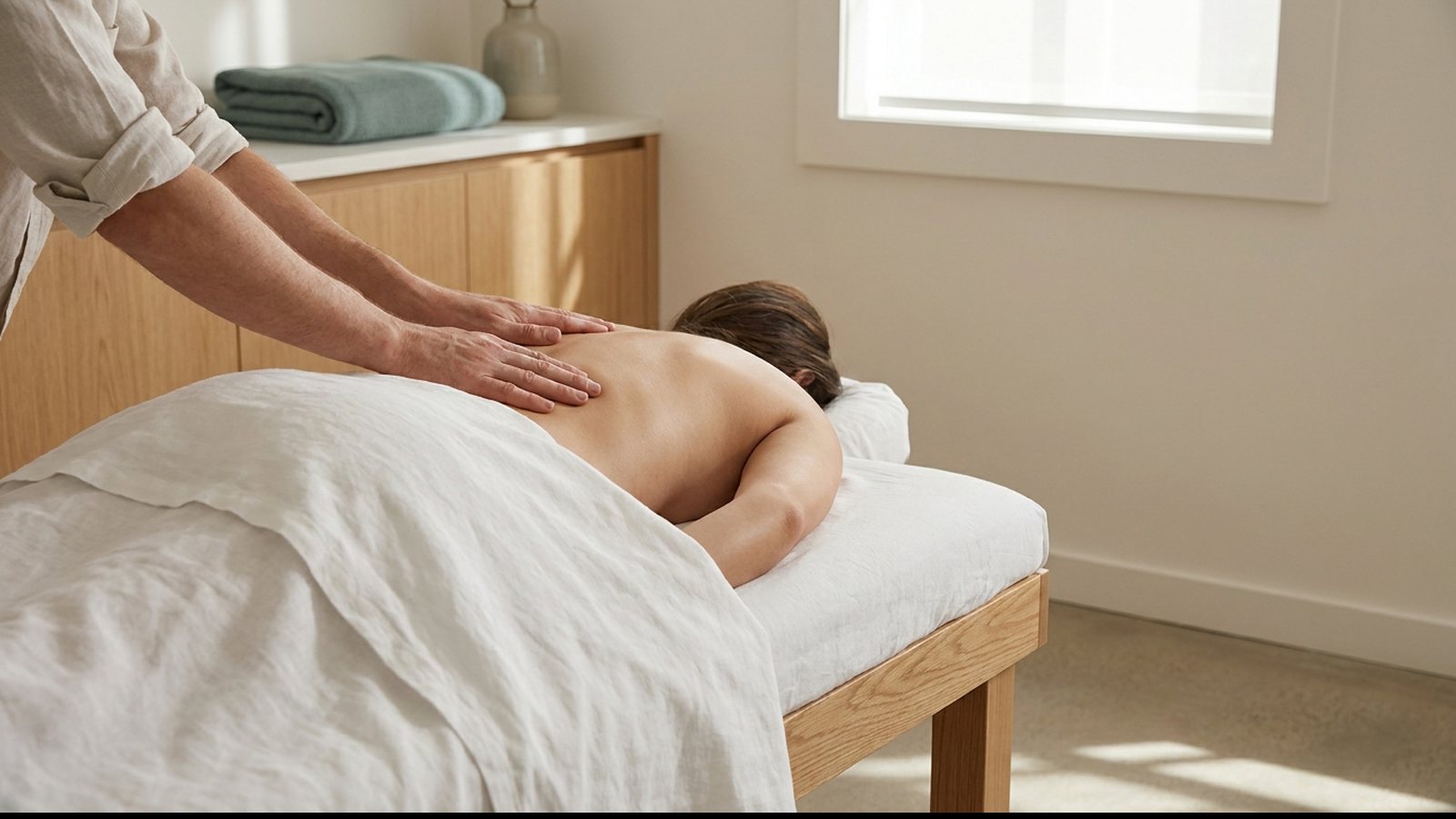
Nothing about it is a spa. The room is quiet and the table is comfortable, but the work is aimed at a specific area for a specific reason, and Dr. Boss has usually named that area before you get on the table.
- We work the muscles along the low back, the hips, and the glutes, because tight hips are a common reason a low back keeps flaring.
- Where there is a hard, tender band that reproduces your pain, we spend time on it rather than gliding past.
- Pressure is a conversation. Deeper is not better, and you should be able to breathe normally the whole time. Say something if you cannot.
- Most people are worked on for the first part of the visit, then adjusted while the tissue is warm.
You can be a little sore the next day, similar to the day after a good workout. Water and normal movement handle most of that. Sharp pain, new numbness, or pain running down a leg is different, and we want to hear about it.
Who this combination suits.
It suits people whose backs get tight and stay tight. Desk workers with a low back that seizes up by Thursday. People whose adjustments feel great and then fade in two days. Anyone carrying old muscle guarding from an injury that healed years ago on paper.
It suits people mid-recovery too. Once a course of care has calmed the joint down, soft tissue work is often what makes the difference between visits.
It is less useful on its own for disc problems. When a disc is pressing on a nerve, the answer is usually taking pressure off the disc, which is what spinal decompression is for. Massage plays a supporting role there, and we will tell you that up front rather than sell you a package.
How we fit it into a plan.
Your first visit is an exam. Dr. Boss finds out whether you have a joint problem, a disc problem, a muscle problem, or some mix of the three, and he shows you what he found on a 3D model of the spine before he touches you.
From there, massage therapy gets used where it earns its place in the plan. Most plans also include therapeutic exercises, because loose muscle that has nothing holding it up tightens again. Strength is what makes the change stick.
We tell you what it costs before you commit, and we give you a real number of visits at the start.
Reviewed by Dr. Christopher Boss, DC, Boss Chiropractic. Last updated September 11, 2026.
This page is general information, not medical advice. What is right for you depends on your exam. Dr. Boss will tell you straight whether we can help, and where to go if we cannot.