
Home / Conditions / Herniated discs
What we help people withHerniated and bulging discs.
A disc that pushes out of place can crowd the nerve sitting right next to it. Often that settles down without surgery if you take the pressure off and give it room. Whether surgery is right for you is a decision for you and your physician, and Dr. Boss will say so if he thinks you need that conversation.
The short version
- A bulging or herniated disc can press on a nerve, but your back is not broken.
- Your exam checks reflexes, strength, and movement to confirm whether a disc is involved.
- Spinal decompression takes pressure off the disc with a slow, controlled pull on a table.
- Pain that retreats from your calf toward your back is a sign of real progress.
- Certain warning signs, like numbness in the saddle area, need an emergency room instead.
What a disc actually is.
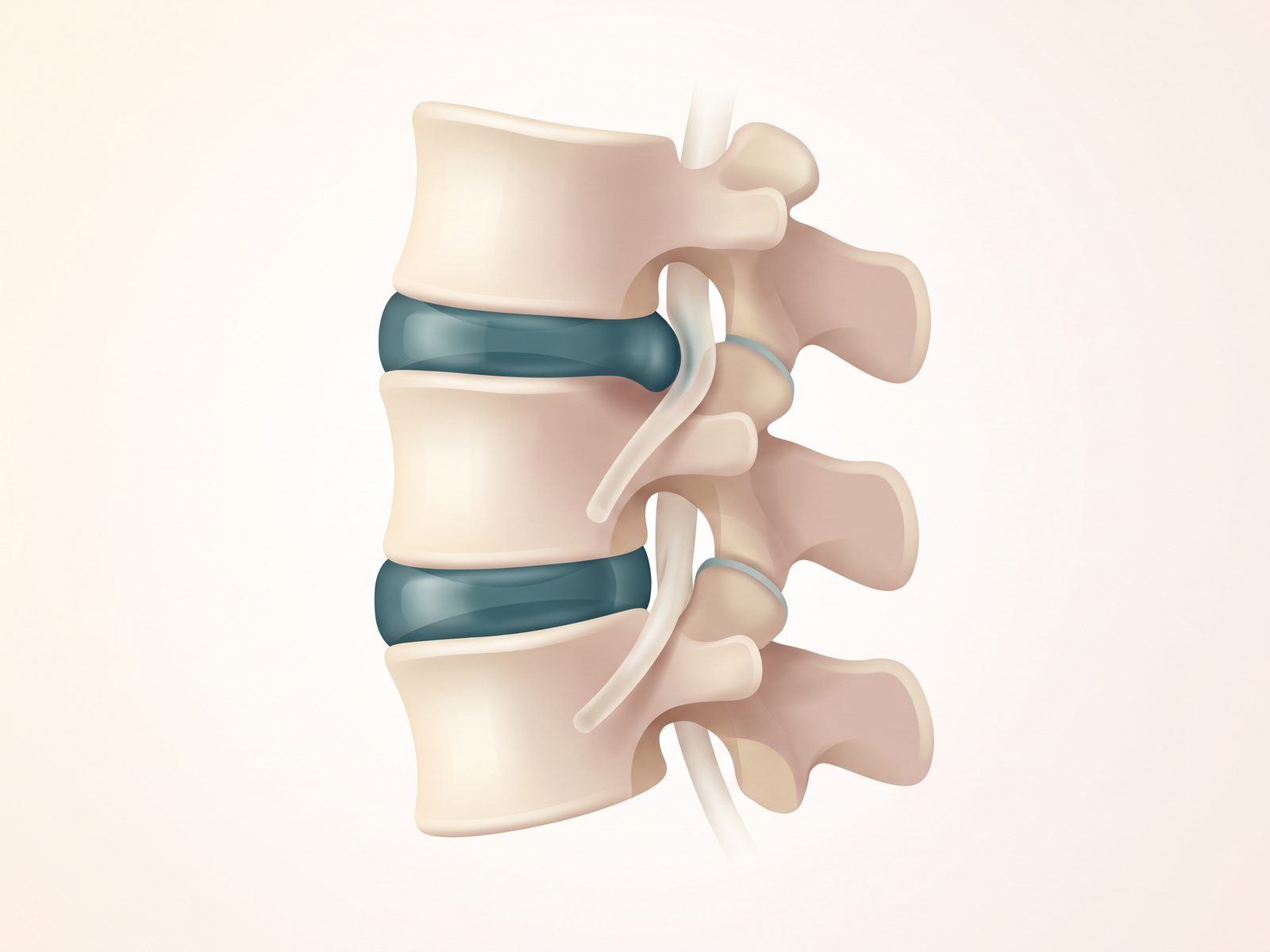
Between each pair of vertebrae sits a disc: a tough outer ring with a soft, jelly-like center. It spaces the bones apart, absorbs load, and lets your spine bend. It is built to take a lot.
A bulge means the outer ring has stretched and the disc pushes past its normal edge. A herniation means the ring has torn and some of the center has pushed through. Either can press on a nerve root or irritate it chemically. Both hurt. Neither means your back is broken.
Plenty of people walk around with disc bulges and feel nothing at all. What matters is not the picture, it is whether that disc is bothering a nerve and how your body responds when we change the pressure on it.
How it usually feels.
In the low back, a disc problem often hurts more sitting than standing. Getting out of the car is the worst moment of the day. Bending forward to tie a shoe is hard. Pain, numbness, or tingling may run into the buttock, down the thigh, and past the knee, which is what most people call sciatica.
In the neck, it shows up as pain into the shoulder blade or down the arm, sometimes with tingling in specific fingers. Looking up or turning toward the painful side often makes it worse. Putting your hand on top of your head sometimes makes it better, which is a useful clue.
Drag to spin. Tap a vertebra to lift it out.See the full model →
How Dr. Boss works out whether it is the disc.
Your exam is built to separate a disc from a joint, a muscle, or a hip. Dr. Boss tests reflexes, strength, and sensation and compares side to side, because a nerve under real pressure leaves fingerprints. He uses position tests to see whether bending one way relieves the symptom and another way sends it further down the limb. He checks which movements you can and cannot do, then checks them again after treatment to see whether anything changed.
If the exam points to a disc with nerve involvement, imaging may be the right next step, and Dr. Boss will tell you when it is. He also uses the 3D spine model to show you where your disc sits and what the nerve beside it is dealing with.
What treatment looks like.
Non-surgical spinal decompression is the main tool. You lie clothed on a motorized table that applies a slow, controlled pull to the spine, then eases off, in cycles. Separating the vertebrae a small amount lowers the pressure inside the disc. Lower pressure means less push against the nerve and a better environment for the disc to heal. Most people find it comfortable enough to fall asleep on the table.
Decompression works as a course, not a single session. Around it we add gentle adjustments to nearby segments that have stiffened up, soft tissue work for the muscles guarding the area, and therapeutic exercises that support the disc rather than load it. Dr. Boss will also tell you which everyday movements to avoid while the ring is healing, because repeated bending and twisting undoes the work.
A good sign of progress with a disc is centralization: pain that used to run to the calf now stops at the thigh, then at the buttock, then stays in the back. That retreat usually happens before the intensity drops, so it is worth watching for.
A disc that causes real muscle weakness, a foot that drags, numbness in the saddle area, or loss of bladder or bowel control is a surgical question, not a chiropractic one. Get to an emergency room. Dr. Boss screens for that on the first visit and will refer you out the same day if he sees it.
What to expect.
Your first visit takes about an hour and ends with a plan and a number. We take most major plans and self-pay is available. Give us your plan details when you book and we will check your coverage before you arrive.
Disc care takes weeks, not days. Nerve tissue calms slowly, and the outer ring of a disc heals slowly because it has a poor blood supply. Expect a course of visits with steady, checkable progress. If you are not moving in the right direction by the point Dr. Boss said you would, the plan changes or you get referred. That is a promise we keep.
Reviewed and approved by Dr. Christopher Boss, DC, Doctor of Chiropractic since 1998 and the treating chiropractor at Boss Chiropractic. Last updated September 11, 2026.
This page is general information, not medical advice. What is right for you depends on your exam. Dr. Boss will tell you straight whether we can help, and where to go if we cannot.
A disc diagnosis does not have to mean surgery.
Come in, see what your disc is doing, and find out what we can do about it.
Book your first visit