
Home / Conditions / Spinal stenosis
What we help people withSpinal stenosis and disc degeneration.
If you can shop for an hour leaning on a cart but cannot stand in line for five minutes, that pattern has a name. It usually means the spaces your nerves travel through have narrowed.
What this page covers
- Spinal stenosis means the spaces your nerves travel through have narrowed.
- Standing and walking bring on leg symptoms that ease when you sit or lean forward.
- Adjustments, decompression, and exercise aim to restore motion and take load off the area.
- Severe stenosis with progressive weakness or loss of bladder or bowel control needs a surgeon.
- Care is measured by how far you can walk, not by what the report calls it.
Narrowing happens slowly, and the two problems travel together.
Stenosis means narrowing. In the spine it refers to the central canal that carries the spinal cord and nerves, or to the smaller openings where nerve roots exit at each level. When those spaces shrink, the nerves have less room than they were built to have.
Degenerative disc disease is the usual starting point, and the name is worse than the thing. It is not really a disease. Discs lose water content with the years, so they get thinner and less springy. As a disc flattens, the vertebrae sit closer together, the small joints behind them take more load, and the body responds by thickening bone and ligament around the area. That extra material is what closes down the space.
The result is a spine that is stiffer and tighter than it once was, with less room to spare. Most of this is normal aging. What matters is how much it interferes with your life, not what the report calls it.
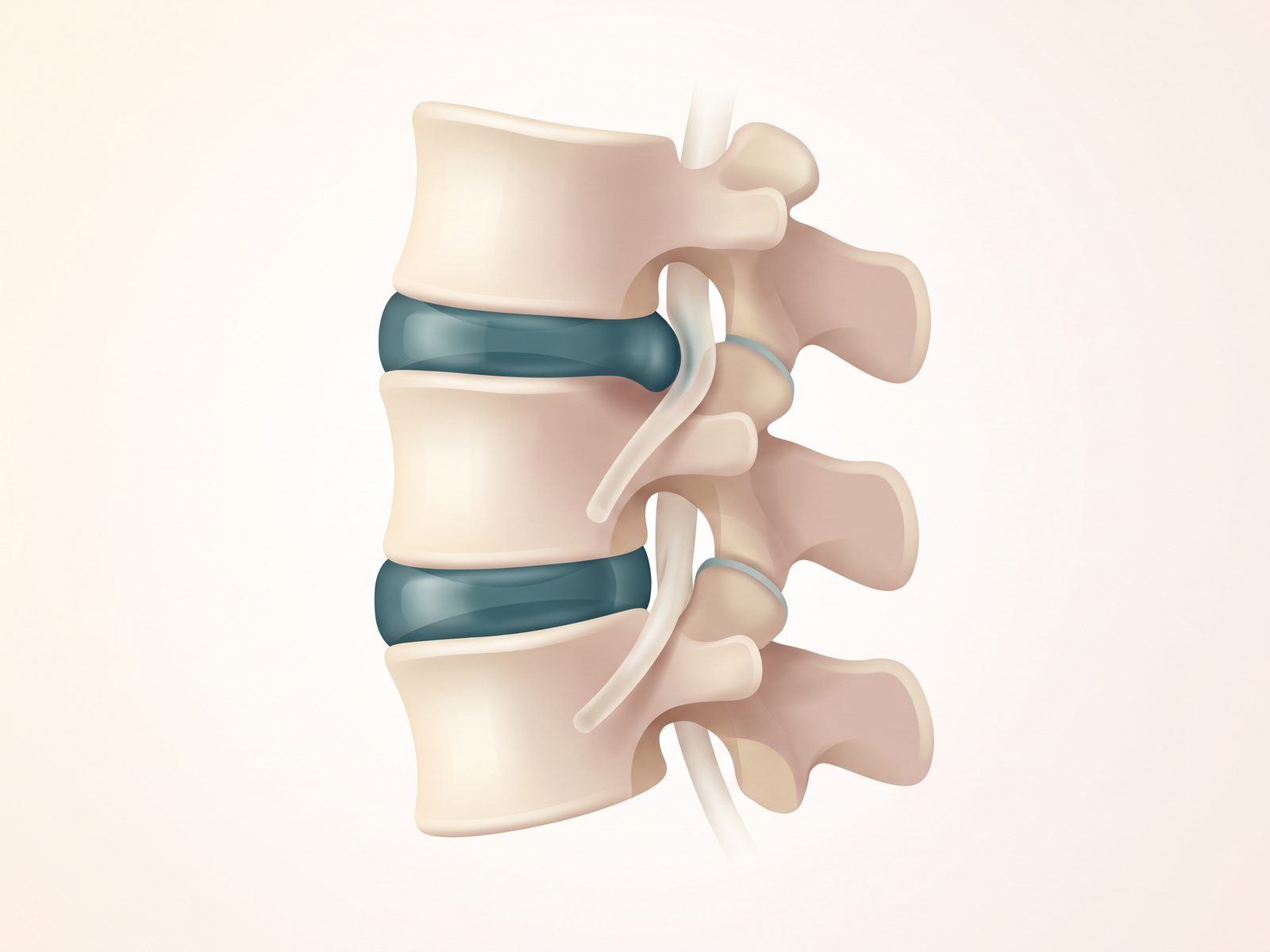
The pattern is what gives it away.
Lumbar stenosis has a signature. Standing and walking bring on aching, heaviness, or burning in the legs. Sitting down relieves it within a couple of minutes. Leaning forward over a cart or a countertop relieves it too, because bending forward opens the canal slightly. Walking uphill is easier than walking downhill for the same reason.
People often describe legs that feel tired and unreliable rather than sharply painful, and both legs are frequently involved. It creeps in over years, so many people adjust their lives around it before they ever mention it.
Degenerative changes on their own tend to feel like a deep, dull stiffness in the low back that is worst in the morning and after long stillness, and eases as you get moving.
Drag to spin. Tap a vertebra to lift it out.See the full model →
How Dr. Boss works out what you have.
Your history does most of the work here, because that walk-and-lean pattern is distinctive. Dr. Boss will ask how far you can walk before symptoms start, what position stops them, and how quickly they stop. He tests position: bending you forward and back to see which direction eases the legs.
He examines reflexes, strength, sensation, and pulses in both legs, because poor circulation can cause leg pain with walking too, and it needs a different doctor. He tests the hips, which mimic low back problems more often than people realize. Imaging is usually part of the picture with stenosis, and Dr. Boss will tell you if you need it.
Then he shows you the 3D model and points out where the space is meant to be and what closes it down. Understanding why leaning forward helps changes how people manage their day.
What treatment looks like.
Nobody can undo bone changes with their hands, and we will not claim to. What we can change is how much motion you have, how much load lands on the narrowed level, and how well the muscles around it support you. Those three things decide how far you can walk.
Gentle, specific adjustments restore motion to the segments above and below that have stiffened up, which takes strain off the tight one. Spinal decompression is often useful, because opening the space between vertebrae is exactly what a narrowed spine needs, and it is done gradually and comfortably on the table.
Soft tissue work and massage therapy release the muscles that have tightened around the area over years.
Therapeutic exercises carry the long-term result. Flexion-based movements, core work, hip mobility, and a walking program built up in short intervals all add distance over time. Progress with stenosis is measured in how far you can walk and how long you can stand, so those are the numbers we track.
Stenosis is managed, not cured. Care aims to give you more comfortable distance and better function, and for many people that is a real change in daily life. Severe stenosis with progressive weakness, numbness in the saddle area, or loss of bladder or bowel control needs a surgeon, and quickly. Dr. Boss screens for that and will refer you.
What to expect.
The first visit takes about an hour and ends with a plan and a cost. We take most major plans and self-pay is available. Give us your plan details when you book and we will check your coverage before you arrive.
Stenosis care is usually a course of visits followed by a lighter, ongoing schedule, because the underlying narrowing is still there. Dr. Boss will be plain with you about that at the start. What we are after is more distance, fewer bad days, and a home program you can keep doing on your own.
Reviewed and approved by Dr. Christopher Boss, DC, Doctor of Chiropractic since 1998 and the treating chiropractor at Boss Chiropractic. Last updated September 11, 2026.
This page is general information, not medical advice. What is right for you depends on your exam. Dr. Boss will tell you straight whether we can help, and where to go if we cannot.
Get more distance out of your legs.
Come in, see what has narrowed, and start working on room and motion.
Book your first visit