
Home / Conditions / Sports injuries
What we help people withSports and overuse injuries.
Most sports injuries are not accidents. They are a joint that stopped moving well, and the tissue next to it taking the extra load until it gave out.
What this page covers
- Acute injuries have a clear moment behind them, while overuse injuries build up slowly.
- Overuse injuries usually mean load landed on tissue covering for a stiff joint nearby.
- The exam covers the injured area and the joints above and below it.
- Early treatment calms the tissue down without shutting you out of activity completely.
- A simple strain caught early often settles within two or three weeks.
Two kinds of injury, two different plans.
An acute injury has a moment attached to it. You planted a foot and something in your knee twisted. You reached for a ball and felt a pull in the hamstring. You landed wrong. There is swelling, bruising, and a clear before and after.
An overuse injury has no moment. It started as a niggle you ran through, then it was there every run, then it was there walking to the car. Runner's knee, shin pain, Achilles trouble, tennis elbow, and shoulder pain from swimming or overhead work all follow that pattern.
Overuse injuries almost always mean load landed somewhere it was not meant to. A stiff ankle sends work up to the knee. A hip that will not extend properly makes the low back and hamstring do more. A locked-up mid back makes the shoulder reach further overhead than it should. Treating only the sore spot leaves the reason in place, which is why the same injury keeps coming back to the same person.
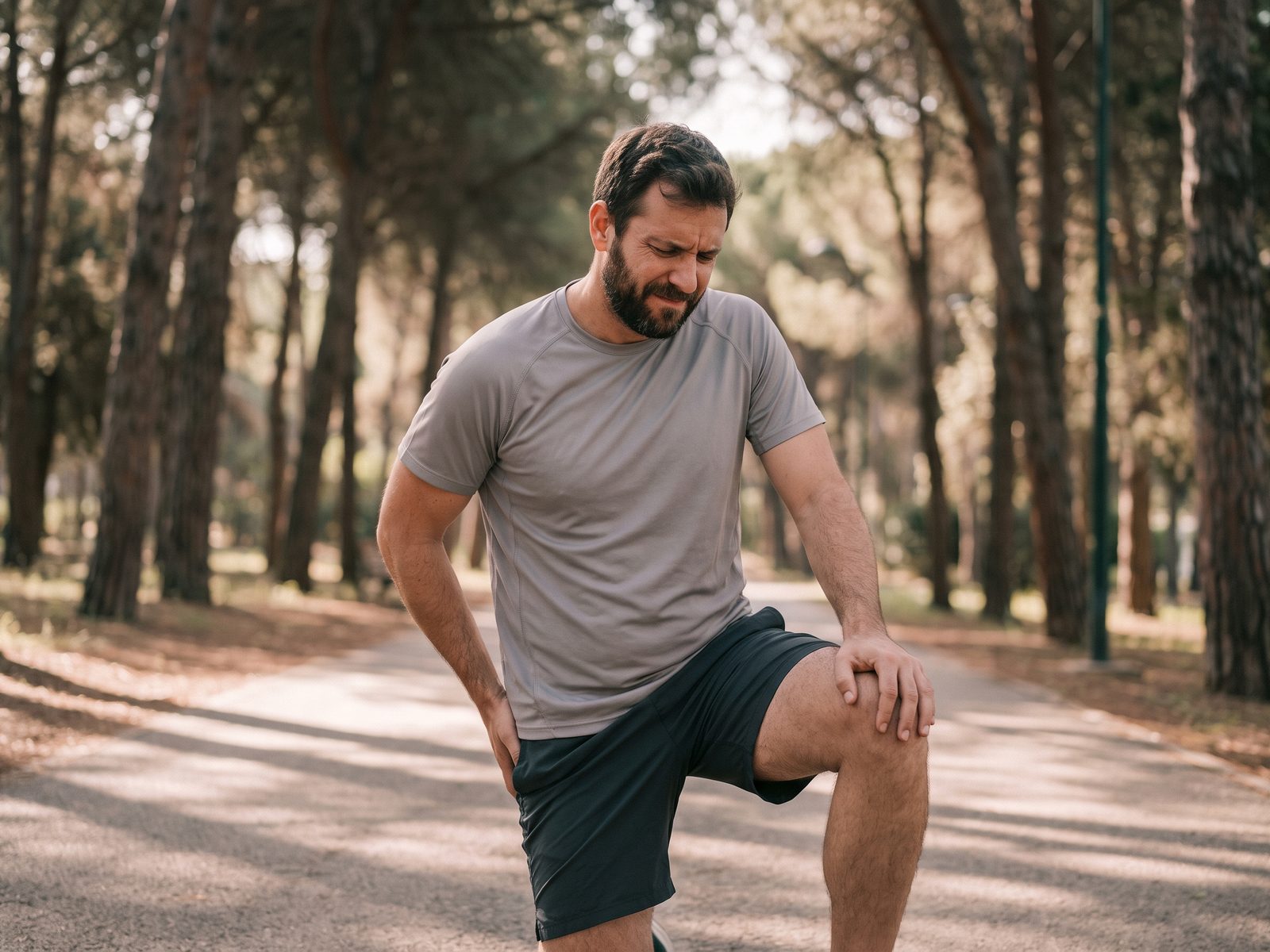
Weekend athletes get hurt differently.
Plenty of our patients in The Woodlands are not competing at anything. They sit at a desk five days a week, then play three sets of tennis on Saturday, or take on the yard, or go all in on a new gym program in January. The body has been in one position all week and then asked for full range at speed.
Training errors cause most of these: a sudden jump in mileage or weight, no warm-up, worn shoes, or one hard week with no easy days after it. Those are fixable once someone points them out.
How Dr. Boss works out what is going on.
He starts with the story, and with overuse injuries the story is the diagnosis. What changed in the four weeks before it started. How far, how heavy, how often. What surface, what shoes, what time of day it hurts, and whether it warms up or worsens as you go.
Then he examines the injured area for what it is: tendon, ligament, muscle, joint, or referred pain from the spine. He tests strength and applies specific stress to the tissue in question. He checks for the things that do not belong to us, like a fracture or a full tear, and refers those out.
Then he looks above and below. A sore Achilles gets an ankle, calf, knee, and hip exam. An aching shoulder gets a neck and mid back exam. That is where the reason usually hides.
What treatment looks like.
Early on, the aim is to calm the tissue down without shutting you down completely. Complete rest feels responsible and usually is not the fastest route. Soft tissue work and massage therapy reduce the tension pulling on the injured area. Adjustments restore motion to the stiff joints that pushed load onto it. We will give you a way to keep training that does not feed the problem, which is often a change of surface, distance, or angle rather than a full stop.
Then comes the rebuild. Therapeutic exercises restore range where you lost it and load the healing tissue in a graded way, because tendons and muscles get stronger by being asked to work, not by being protected. This is the phase most people skip, and it is the phase that decides whether it comes back next season.
Last, we look at the return to sport. Adding load slowly, warming up properly, and giving hard days an easy day afterward prevents more injuries than any treatment does.
Some injuries need an emergency room or an orthopedic surgeon, not us. A joint that looks deformed, one you cannot put weight on at all, a pop followed by the knee giving way, obvious instability, numbness that will not resolve, or a rapidly swelling joint all need imaging first. Dr. Boss checks for these before treating anything and will send you on the same day.
What to expect.
The first visit takes about an hour: history, exam of the injured area and the joints feeding it, and a plan with a cost before you commit. We take most major plans and self-pay is available. Give us your plan details when you book and we will check your coverage before you arrive.
A tendon that has been grumbling for six months takes longer, because tendons adapt slowly and there is no shortcut around that. Dr. Boss will give you an honest timeline and a return-to-sport plan rather than a vague promise, and he will tell you when it is safe to push.
More reading: spinal injury rehab, step by step.
Reviewed and approved by Dr. Christopher Boss, DC, Doctor of Chiropractic since 1998 and the treating chiropractor at Boss Chiropractic. Last updated September 11, 2026.
This page is general information, not medical advice. What is right for you depends on your exam. Dr. Boss will tell you straight whether we can help, and where to go if we cannot.
Fix the injury and the reason it happened.
Get examined, get a plan, and get back to your sport on a schedule.
Book your first visit